The Complete Guide to Home Cost Basis for U.S. Homeowners
Everything US homeowners need to know about cost basis — how it works, what raises and lowers it, and why getting it right saves thousands at sale time.
By Matt Price
Founder & Builder, DwellRecord
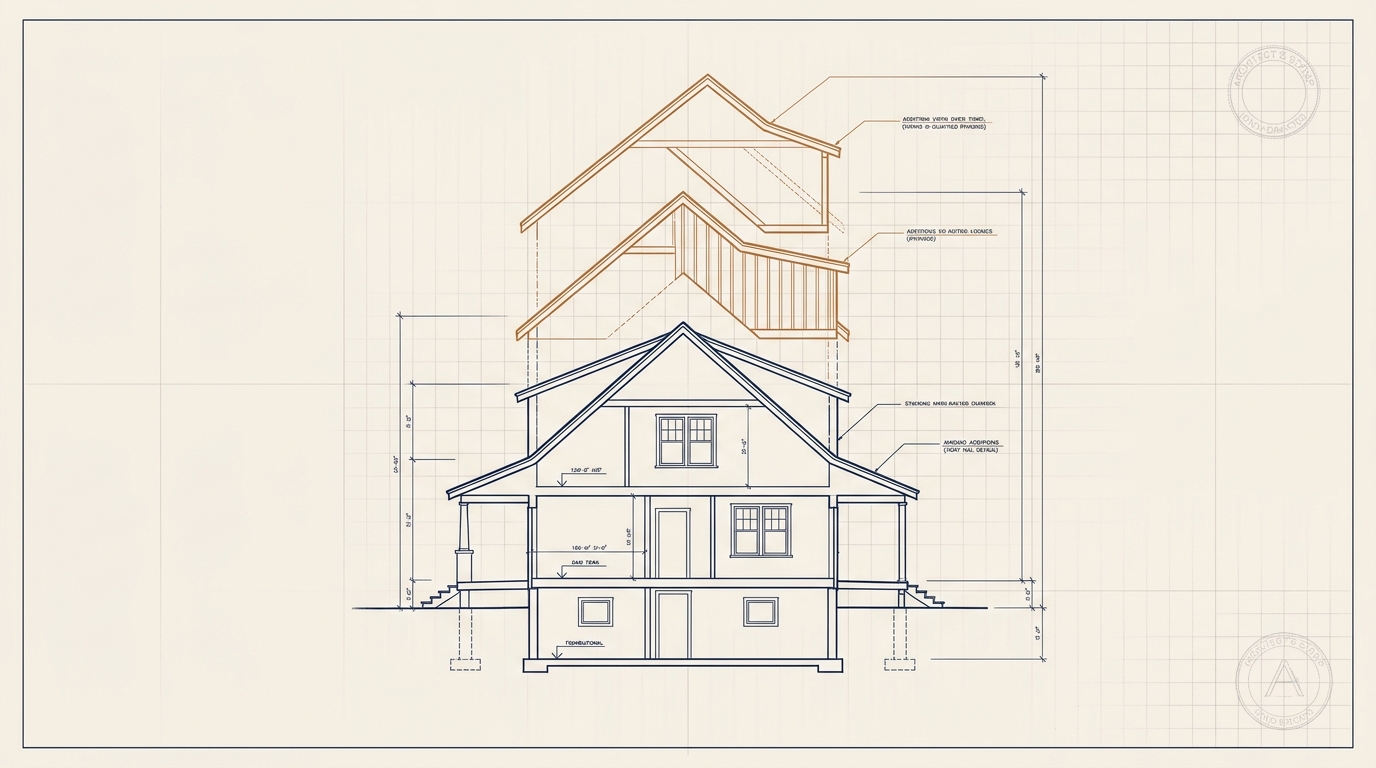
Your home's cost basis is the single most important tax number most homeowners have never calculated. It's the figure the IRS uses to decide how much of your home sale is taxable, and it's the reason two neighbors who sell identical homes for identical prices can end up with wildly different tax bills.
This is the complete guide to home cost basis for U.S. homeowners. It covers what basis is, what raises it, what lowers it, how to handle the special cases (inheritance, divorce, rental conversions), how it interacts with the §121 primary residence exclusion, and exactly what documentation you need to defend it if the IRS asks.
What Cost Basis Actually Is
Cost basis is what the IRS considers you to have "paid" for your home for tax purposes. It starts with your purchase price but almost never ends there. Every qualifying improvement you make raises it. Certain deductions and depreciation you've taken lower it. When you sell, the difference between your sale price and your basis is your capital gain — and that's what gets taxed.
The math looks like this:
- Sale price minus selling expenses = amount realized
- Amount realized minus adjusted cost basis = capital gain
- Capital gain minus §121 exclusion = taxable gain
The IRS spells all of this out in Publication 523, "Selling Your Home", the definitive reference for this calculation.
If you get your basis right, you pay exactly what you owe. If you can't prove your basis, the IRS will generally use the lowest defensible number — usually just your purchase price — which maximizes your taxable gain and your tax bill.
Starting Basis: What You Originally "Paid"
Your starting cost basis is not just the number on the purchase agreement. It includes several components that most homeowners forget:
Purchase Price and Settlement Costs
The largest component is what you paid the seller. But the IRS also lets you include specific settlement and closing costs in your basis. Per IRS Publication 523, these include:
- Abstract fees
- Charges for installing utility services
- Legal fees (title search, preparing the sales contract, preparing the deed)
- Recording fees
- Survey fees
- Transfer or stamp taxes
- Owner's title insurance
- Any amount the seller owed that you agreed to pay (back taxes, back interest, recording or mortgage fees, improvements, sales commissions)
Assumed Debt
If you took over an existing mortgage or other debt on the property, the amount of debt assumed becomes part of your basis.
Gift Tax Paid
If the home was partially a gift and the giver paid gift tax attributable to the property's appreciation, some portion of that gift tax may be added to basis. This is a niche case — if it applies to you, you need a CPA to calculate it.
Additions: What Raises Your Basis
This is the category where homeowners leave the most money on the table. Every qualifying capital improvement you make over your entire period of ownership raises your basis. Do it for 20 years and the running total can be six figures.
See the companion guide What Actually Counts as a Capital Improvement for the complete IRS test and the full list of qualifying categories. The short version:
- Additions — new rooms, decks, garages, finished basements
- Lawn and grounds — permanent landscaping, driveways, retaining walls, sprinkler systems
- Exterior — new roof, siding, storm windows, full-home window replacement
- Plumbing — water heater, septic, re-piping, filtration
- Heating & AC — new HVAC, duct work
- Insulation — attic, wall, floor, duct
- Interior — built-in appliances, kitchen/bath modernization, new flooring, fireplaces
- Security — hardwired systems, wiring upgrades, accessibility modifications
Repairs don't qualify. Painting a room, fixing a leaky faucet, patching a section of roof — these keep the home in its existing condition without materially improving it. For the full rules, see our capital improvement vs. repair guide.
Assessments and Special Charges
Special assessments for local improvements — new sewer lines, sidewalks, street paving — that benefit your property generally add to basis. Annual property tax is a deductible expense, not a basis adjustment.
Legal Fees to Defend Title
If you spend money defending or perfecting title to your home (e.g., a boundary dispute), those legal fees add to basis.
Deductions: What Lowers Your Basis
Basis adjustments work both ways. Several items reduce your basis:
Depreciation on a Home Office or Rental Use
If you claimed the home office deduction and depreciated part of your home for business use, that depreciation reduces your basis. If you rented out part of the home or used it as a rental property for any period, depreciation taken during that period also reduces basis. This is one of the most common audit-surviving adjustments and the one that most surprises sellers.
Casualty Loss Deductions
If an improvement was destroyed in a casualty (fire, flood) and you took a casualty loss deduction, that amount comes out of your basis. The insurance payout also comes out. Essentially, the IRS doesn't let you get the tax benefit of the improvement twice.
Energy Credits Previously Claimed
If you took the Residential Clean Energy Credit or the Energy Efficient Home Improvement Credit (both expired at the end of 2025 under the One Big Beautiful Bill Act), the credit amount you received reduces the basis you can add for the same improvement. If your $15,000 heat pump got a $2,000 credit, you add $13,000 to basis, not $15,000.
Payments From Federal Subsidy or Settlement Programs
Mortgage assistance, FHA insurance rebates, and similar federal subsidies can reduce basis depending on how they're received. Check your specific situation.
Adjusted Cost Basis: Putting It Together
Your adjusted cost basis at sale is:
Starting basis
+ All qualifying capital improvements made during ownership
+ Assessments for local improvements benefiting the property
+ Legal fees to defend or perfect title
− Depreciation claimed (home office, rental use)
− Casualty loss deductions taken
− Energy credits received for improvements
− Federal subsidies that require basis reduction
= Adjusted Cost Basis
This is the number that matters at sale.
Special Situation 1: Inherited Homes (Stepped-Up Basis)
If you inherited a home, your starting basis is usually the home's fair market value on the date the original owner died — not what the original owner paid for it. This is called a stepped-up basis and it's one of the most valuable provisions in the U.S. tax code. Your parents' $80,000 home that was worth $500,000 when they passed gets a new basis of $500,000 in your hands. The decades of appreciation never get taxed.
A qualified appraisal dated at or near the date of death is the best documentation. If you skipped this step, comparable sales records from that month can usually reconstruct the value.
For community property states and trust structures, rules vary. This is an area where working with a CPA or tax attorney pays for itself many times over.
Special Situation 2: Gifted Homes
If someone gave you a home while still living, you generally take the giver's basis (this is called carryover basis). If your parents bought for $150,000 and gifted it to you, your basis is $150,000 regardless of current value.
Exception: if the home's fair market value at the time of gift was less than the giver's basis, and you later sell at a loss, you use fair market value at gift as your basis for loss purposes.
Gifted homes lose the stepped-up basis benefit — which is why estate planning attorneys often advise aging parents to hold title until death rather than gift during life.
Special Situation 3: Rental Conversions
If you converted a rental property to your primary residence (or vice versa) during ownership, basis gets complicated quickly. Different periods of use have different rules, and depreciation from the rental period follows you into the primary residence calculation.
Summary: if the property was ever a rental, you need a CPA at sale time. No exceptions.
Special Situation 4: Divorce Transfers
Transfers between spouses incident to divorce are generally non-taxable events under IRC §1041. The receiving spouse takes the giving spouse's basis (carryover basis). If one spouse "buys out" the other's share, that payment does not increase basis — it's a tax-free transfer.
The §121 Primary Residence Exclusion
The reason basis matters at all is the primary residence exclusion under IRC §121. Most homeowners can exclude:
- $250,000 of gain if filing single
- $500,000 of gain if married filing jointly
To qualify, you must have owned and used the home as your main home for at least two of the five years before the sale. The two years don't have to be continuous. You can only claim this exclusion once every two years.
Partial exclusions are available if you sold for work, health, or unforeseen circumstances before hitting the two-year mark. Publication 523 has a worksheet.If your gain after basis adjustments is under the exclusion, you owe zero federal tax on the sale. That's why tracking basis is worth it even if you think you're "under" the threshold today — home values change, and your exclusion either covers the gain or it doesn't.
State Capital Gains on Home Sales
Seven states have no capital gains tax at all (Alaska, Florida, Nevada, New Hampshire, South Dakota, Tennessee, Texas, Washington, Wyoming — Washington now has a limited capital gains tax on non-real-estate gains only). Most other states tax capital gains as ordinary income, with rates from 3% to 13.3% (California). A handful offer their own home-sale exclusion.
State rules for basis generally mirror federal rules but not always. If you live in a high-tax state, the basis calculation matters twice — once federally and once at state level.
What Documentation You Actually Need
If the IRS audits your basis calculation at sale, you need to be able to produce:
- Original closing documents (HUD-1 or Closing Disclosure) showing purchase price and allowable settlement costs
- Contractor invoices and receipts for every capital improvement
- Permits pulled for work requiring them
- Before and after photos for structural work
- Assessment records for any local-improvement assessments paid
- Appraisals for inherited homes (dated at or near date of death)
- Tax returns showing any depreciation or credits claimed for the home
- Divorce decree or settlement agreements if applicable
Keep these for the entire period you own the home plus seven years after sale — the IRS can audit a home sale for up to six years in some circumstances.
How to Actually Track This
The three things that fail:
- Shoebox method — receipts fade, folders get lost, and at sale time you're reconstructing a decade of work from memory.
- Spreadsheet alone — better than shoebox, but photos and receipts live elsewhere. When you move computers or lose a drive, the trail breaks.
- Email search — captures the paid-online invoices but misses cash payments, paper receipts, and anything older than your current email account.
What works: a single system that stores every improvement with the date, cost, contractor, receipt image, and before/after photos, and gives you a running total.
That's exactly what DwellRecord does. You log each improvement as it happens — kitchen remodel, new roof, HVAC replacement — attach the receipts and photos, and your adjusted cost basis calculates automatically. When you sell, you export a single PDF with everything your CPA or attorney needs. Start tracking your improvements for free.
Frequently Asked Questions
Can I reconstruct basis for improvements I never documented?You can attempt to — bank statements, contractor records, permit history, credit card statements. The IRS may accept partial reconstruction, especially with corroborating evidence. But undocumented claims are audit-vulnerable. Start documenting now.
Do I adjust basis for inflation?No. Basis is nominal dollars. If you bought for $200,000 in 1995 and sold for $800,000 in 2026, your gain is $600,000 (before improvements), not inflation-adjusted.
Does my down payment or mortgage affect basis?No. Basis is the total cost of the home, not the portion you paid in cash. A $500,000 home purchased with $100,000 down and a $400,000 mortgage still has a $500,000 starting basis.
What if I refinanced during ownership?Refinancing doesn't affect basis. The closing costs on a refinance are not basis adjustments (they're amortized over the life of the loan for interest-deduction purposes only).
What if I sold at a loss?Losses on the sale of a personal residence are generally not deductible. The IRS treats personal-use property asymmetrically: gains are taxable (above the exclusion), losses are not deductible.
Does a home equity loan change anything?No. Equity loans don't change basis. Interest may be deductible separately depending on use of proceeds.
Related Guides
- Do Home Improvements Cut Capital Gains Tax? — the core math on how improvements reduce your taxable gain at sale.
- What Counts as a Capital Improvement — the IRS 3-part test with every qualifying category.
- How to Track Home Improvements for Taxes — the documentation system that holds up at sale time.
- Documents Needed When Selling Your House — the full closing-day checklist, including improvement records.
The Bottom Line
Cost basis is boring to think about while you own a home and expensive to think about when you sell one. Get it right and you pay exactly what you owe. Get it wrong — or worse, leave it undocumented — and you pay tax on appreciation you shouldn't.
The best time to start tracking was when you bought the house. The second best time is today.
Editorial, not advice. This article is educational and reflects publicly available IRS, state, and insurance guidance at the time of writing. It is not tax, legal, or insurance advice. For decisions that touch your specific situation, consult a CPA, enrolled agent, tax attorney, or licensed insurance professional in your state. DwellRecord keeps the record — your advisor makes the call.
Last reviewed:
Ready to protect your home investment?
Start documenting your improvements, assets, and warranties for free.
Get Started Free