What Actually Counts as a Capital Improvement for Tax Purposes (2026 Guide)
A capital improvement adds value to your home, prolongs its useful life, or adapts it to new uses. Here's exactly what the IRS counts — with real examples.
By Matt Price
Founder & Builder, DwellRecord
Part of our tax basis series: see The Complete Guide to Home Cost Basis for the full framework. This post zooms in on the IRS test that decides which projects actually count.
A capital improvement is a home project that either adds value, extends the property's useful life, or adapts it to a new use. The IRS defines this in Publication 523. A new roof qualifies. Patching a leak does not. The distinction matters because capital improvements increase your home's cost basis, which reduces your taxable gain when you sell — potentially saving you thousands in federal and state capital gains tax.
Why This Question Matters
Every homeowner has made improvements. New flooring, a remodeled bathroom, a replaced furnace. When you sell your home for a gain that exceeds the IRS primary residence exclusion — $250,000 single, $500,000 married filing jointly — those improvements directly reduce what you owe. See our companion guide on how home improvements reduce capital gains tax for the full math.
But not every project qualifies. Paint a room and the IRS considers it a maintenance repair. Add a deck and the IRS considers it a capital improvement. The line is clear in definition but fuzzy in practice, and most homeowners guess wrong either way — either writing off projects that don't qualify, or failing to claim ones that do.
This guide walks through the exact IRS test, lists every category that qualifies, flags the common gray areas, and shows you what documentation you need if the IRS ever asks.
The 3-Part IRS Test
A project qualifies as a capital improvement if it meets at least one of three criteria:
- It adds value to your home — The improvement makes your property worth more than it was before.
- It prolongs the home's useful life — The improvement extends how long the home (or a major component) will last.
- It adapts the home to a new use — The improvement changes how the home is used, like converting a basement into a rental unit.
A repair, by contrast, simply keeps the home in its existing condition. Replacing a broken doorknob restores normal function. Replacing every door in the house is a project that adds value and prolongs useful life.
The IRS publishes a complete list in Publication 523, Table 1. Here's the practical breakdown.
What Counts as a Capital Improvement
The IRS groups qualifying improvements into eight categories.
1. Additions
Anything that expands the physical footprint of the home:
- Room additions
- New bedrooms, bathrooms, dens
- Sunrooms and three-season rooms
- Decks and porches
- Patios (permanent, not pavers over grass)
- Garages and carports
- Storage sheds (if permanent)
- Finished basements and finished attics
2. Lawn and Grounds
Work that improves the land around the home, not routine maintenance:
- Landscaping that adds permanent value (not seasonal plantings)
- New driveways
- Walkways and paths
- Retaining walls
- Fences
- Sprinkler systems
- Ponds or water features
Mowing your lawn is not a capital improvement. Installing a new irrigation system is.
3. Exterior
Major work on the outside of the home:
- New roof (full replacement)
- New siding
- Storm windows and storm doors
- Replacement windows (full-home replacement)
- Satellite dish installation (if part of structure)
4. Plumbing
Major plumbing upgrades:
- New water heater
- Soft water system
- Filtration system
- Septic system
- Re-piping the home
Fixing a leaky faucet is not an improvement. Replacing the entire plumbing system is.
5. Heating & Air Conditioning
HVAC systems have a long useful life, so replacements and major upgrades qualify:
- New heating system (furnace, boiler, heat pump)
- Central air conditioning
- New duct work
- Air filtration or humidification system
Servicing your existing furnace is maintenance. Replacing it is an improvement.
6. Insulation
Energy improvements that become part of the home:
- Attic insulation
- Wall insulation
- Floor insulation
- Pipe and duct insulation
- Weather stripping (if part of a broader improvement)
7. Interior
Improvements inside the home that are permanent:
- Built-in appliances (built-in refrigerator, cooktop, oven — not free-standing)
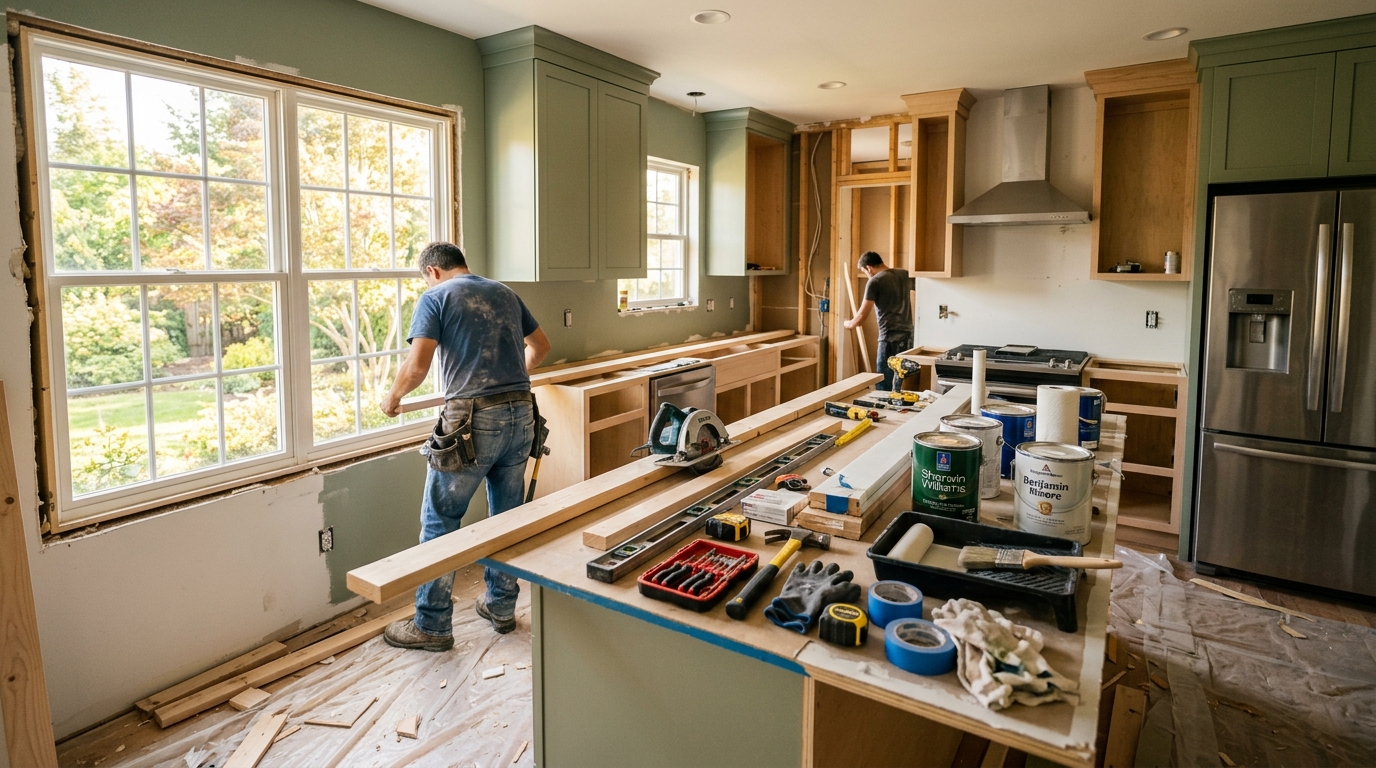
- Kitchen modernization (full or partial remodel)
- Bathroom modernization
- New flooring (hardwood, tile, carpet if installed wall-to-wall)
- Fireplaces
- Built-in bookcases or cabinetry
Free-standing appliances like a portable refrigerator don't qualify because they're personal property, not part of the home.
8. Miscellaneous
- Security systems (hardwired, not plug-in)
- Wiring upgrades
- Smoke detectors (hardwired)
- Accessibility modifications (ramps, wider doorways, grab bars) — may also qualify for medical deductions
What Doesn't Count: Repairs
A repair keeps the home in its normal operating condition without making it materially better than before. Repairs are not capital improvements and don't increase your cost basis.
Common repairs:
- Painting (interior or exterior, if done alone)
- Fixing gutters, floors, leaks
- Replacing a single broken window pane
- Patching a section of the roof
- Fixing a broken step
- Replacing a broken appliance with a similar one
- Cleaning (drains, chimneys, etc.)
- Tuning up the HVAC system
The same dollars spent differently can land on either side of the line. Replacing the entire kitchen counter is an improvement. Fixing a chip in the counter is a repair.
The Gray Areas
The IRS rules are clear in principle and frustrating in practice. Here are the most common judgment calls.
Painting
Painting alone is generally a repair. But painting as part of a larger remodel — repainting after a full kitchen renovation, for example — is typically rolled into the cost of the improvement itself. If you're painting a room that you also added flooring, wiring, and built-in shelving to, the paint becomes part of the qualifying improvement.
Roof Work
A full roof replacement qualifies as a capital improvement. Patching a section doesn't. What about replacing half the roof after a storm? That one lands in the "it depends" bucket. Keep the documentation and let your accountant make the call based on whether it's a reasonable partial replacement or a true repair.
Appliances
Built-in appliances qualify. Free-standing appliances don't, even if they're expensive. A built-in Sub-Zero refrigerator is part of the home. A Sub-Zero you could unplug and take with you is personal property.
Landscaping
Seasonal plantings and lawn care are routine maintenance. Permanent landscaping — a new lawn, trees you're adding, permanent flower beds, hardscaping — is a capital improvement.
Windows
Replacing every window in the home qualifies. Replacing two windows on the front of the house during a siding replacement likely qualifies as part of the broader improvement. Replacing one broken window pane is a repair.
Finished Basement or Attic
Finishing previously unfinished space is an improvement. Refinishing a basement that was already finished (new carpet, new paint) is usually a repair unless it includes structural changes.
Special Cases You Need to Know
Insurance Reimbursements
If insurance paid for part of an improvement — for example, a new roof after a covered storm — only the portion you paid out of pocket counts toward your basis. The reimbursed amount is excluded.
Energy Tax Credits
If you claimed a federal tax credit for a qualifying energy improvement (solar panels, heat pumps, windows under the Energy Efficient Home Improvement Credit), you generally must reduce the basis by the amount of the credit. Check the specific rules for each credit — some are "above the line" and don't affect basis, others do.
Improvements You Later Removed
If you added a deck and later tore it down, the deck doesn't count anymore. Only improvements that still exist when you sell are in your basis.
Casualty Losses
If an improvement was destroyed in a casualty (fire, flood) and you took a casualty loss deduction, that amount comes out of your basis.
Record-Keeping Requirement
The IRS doesn't require you to submit documentation when you file. But if they audit your return, you must be able to substantiate every improvement included in your basis — with receipts, contracts, permits, or other contemporaneous records. The statute of limitations on basis records extends until three years after you sell the home and file that return, which can easily mean holding paperwork for 20+ years. Our guide on documents needed when selling your house covers the full list.
Frequently Asked Questions
Is a new roof a capital improvement?
Yes. A full roof replacement qualifies as a capital improvement because it prolongs the useful life of the home. Patching a section of the roof is a repair, not an improvement. Keep the contractor invoice and any permits as documentation.
Is a kitchen remodel a capital improvement?
Yes. Kitchen modernization — whether a full gut remodel or a partial one including new cabinets, counters, and built-in appliances — qualifies as a capital improvement because it adds value to the home. The cost of painting done as part of the remodel typically rolls in as well.
Do new appliances count as capital improvements?
Only built-in appliances. A built-in oven, cooktop, dishwasher, or microwave that's physically attached to the home qualifies. Free-standing appliances like a refrigerator or washer-dryer don't, even though they're expensive, because they're considered personal property.
Is painting a capital improvement?
Painting alone is typically a repair, not a capital improvement. But painting done as part of a larger qualifying renovation — repainting after a kitchen remodel, for example — usually rolls into the improvement's cost.
Does landscaping count as a capital improvement?
Permanent landscaping that adds value qualifies: new trees, hardscaping, retaining walls, sprinkler systems. Routine lawn care, seasonal plantings, and maintenance don't.
Are solar panels a capital improvement?
Solar panels are a capital improvement, but if you claimed the federal Residential Clean Energy Credit, you typically must reduce your basis by the credit amount. Keep your Form 5695 and installer invoices.
How long do I need to keep home improvement records?
The IRS recommends keeping records for at least three years after you sell the home and file that tax return. Practically, that means holding documentation for as long as you own the home, plus three years. For a 20-year homeowner, that's 20+ years of records.
What if I don't have receipts for old improvements?
You can still claim improvements made before you started keeping records, but you'll need to substantiate them another way — contractor estimates, permits pulled at the county, before-and-after photos, canceled checks, credit card statements. The more contemporaneous the evidence, the stronger your position in an audit.
Do repairs count if they're part of an improvement?
Yes. Repair costs that are part of a larger remodeling or restoration project are treated as improvements and added to basis. A leaky pipe fixed during a bathroom remodel rolls into the bathroom's capital improvement cost.
Does a new water heater count as a capital improvement?
Yes. A new water heater qualifies because it replaces a major system component and has a useful life of 10-15 years. Servicing or repairing your existing water heater is a repair.
How to Track This Without Losing Your Mind
The reason most homeowners undercount their cost basis isn't that they didn't make improvements. It's that they lost the records.
A paper folder in a filing cabinet works if you're disciplined. Most people aren't. The receipts fade, the folder gets stuffed with unrelated paperwork, and by the time you're selling you've lost track of which projects were actually improvements versus repairs. Our guide on how to track home improvements for taxes walks through the full system.
DwellRecord was built to solve exactly this problem. Every improvement you log gets categorized, dated, and tied to a receipt photo. When you sell your home, you can export a single professional PDF to hand to your accountant — every improvement, every dollar, every receipt.The app automatically separates capital improvements from repairs based on the IRS categories above. No more guessing which projects qualify. No more digging through old email for a 2019 contractor invoice.
It takes about two minutes to log a project. The tax savings when you sell can run into the tens of thousands.
Sources
- IRS Publication 523, Selling Your Home — official definitions of capital improvements, basis, and exclusions
- IRS Topic 701, Sale of Your Home — capital gains treatment
- IRS Energy Efficient Home Improvement Credit — how energy credits affect basis
- Internal Revenue Code §1016 — adjustments to basis
---
*This guide is for informational purposes only and does not constitute tax advice. Consult a qualified tax professional before making decisions about your specific situation. Rules and amounts are subject to change for future tax years.*
Editorial, not advice. This article is educational and reflects publicly available IRS, state, and insurance guidance at the time of writing. It is not tax, legal, or insurance advice. For decisions that touch your specific situation, consult a CPA, enrolled agent, tax attorney, or licensed insurance professional in your state. DwellRecord keeps the record — your advisor makes the call.
Last reviewed: · Originally published
Ready to protect your home investment?
Start documenting your improvements, assets, and warranties for free.
Get Started Free