RCV vs. ACV: Which Homeowners Insurance Coverage You Actually Have
Replacement Cost Value and Actual Cash Value pay out wildly different amounts on the same claim. Here is how to tell which you have, and when to upgrade.
By Matt Price
Founder & Builder, DwellRecord
Part of our insurance series: the full framework lives in The Complete Home Inventory Guide for Insurance Claims. This post zooms in on the single policy term that most changes your settlement.
Two homeowners in the same neighborhood, with the same mid-range TV, can file identical theft claims and walk away with dramatically different checks. One gets $1,500. The other gets $450. The TV, the policy brand, and even the deductible can be identical — and the settlement still differs by 70%.
The difference is a single term buried on your declarations page: whether your personal property is insured on a Replacement Cost Value (RCV) basis or an Actual Cash Value (ACV) basis.
Most homeowners have never heard these terms, can't tell you which one their policy uses, and only learn the distinction when an adjuster hands them a settlement check that's smaller than expected. Here's what the two methods actually mean, how to find out which you have, and when it makes sense to pay the small premium difference to upgrade.
What the Two Terms Actually Mean
Per the Insurance Information Institute's breakdown of policy types:
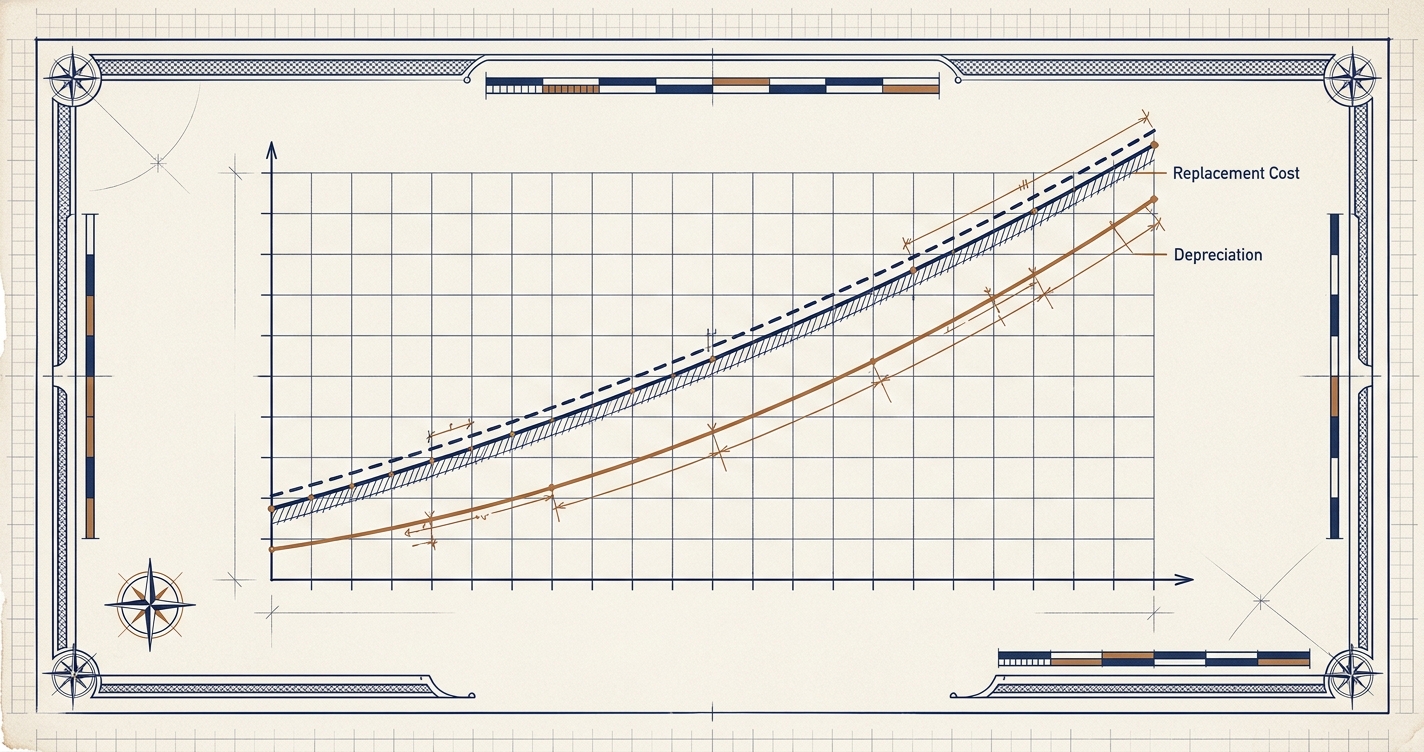
Replacement Cost Value (RCV) pays what it costs to buy a comparable new item at today's prices, regardless of how old or worn the original item was. Actual Cash Value (ACV) pays replacement cost minus depreciation — the insurer deducts for age, wear, and obsolescence before cutting the check.That's the whole distinction. The practical consequences are large.
The $1,500 TV Example
A concrete illustration.
You bought a 65" TV five years ago for $1,500. It's been wall-mounted in your living room ever since. A burglar takes it.
Under RCV: the insurer looks at what a comparable new 65" TV costs today. Prices have come down, so maybe that's $900. You get $900. Under ACV: the insurer applies depreciation. TVs typically depreciate at roughly 10–15% per year. At five years, an insurer might value your TV at 40% of replacement cost, or $360. You get $360.Same policy terms otherwise. Same deductible. Same coverage limits. The payout differs by $540 on a single item — and that's a relatively modest example. On a washer, dryer, and refrigerator all destroyed in a kitchen fire, the gap can easily hit $3,000–$5,000.
How Depreciation Actually Gets Calculated on ACV
Insurers use depreciation schedules that vary by category. These aren't published as a public standard, but the general ranges:
- Electronics: 10–20% per year (TVs, computers, phones)
- Major appliances: 5–10% per year (washers, dryers, refrigerators)
- Furniture: 5–10% per year (often slower if well maintained)
- Clothing: 20–30% per year
- Bedding, linens: 20–40% per year
- Jewelry, fine art, collectibles: typically don't depreciate and may even appreciate — these categories usually require separate scheduling regardless of RCV/ACV
Age matters. Condition matters. Category matters. You won't know exactly how your insurer depreciates until they do it.
How to Tell Which You Have
Pull your declarations page — the one-page summary of your policy. Look for:
- "Replacement Cost" or "RC" in the personal property section → you have RCV
- "Actual Cash Value" or "ACV" in the personal property section → you have ACV
- Nothing explicit → check your full policy document (search for "loss settlement")
Many policies have different methods for different coverages. It's common to have RCV on the dwelling (Coverage A) and ACV on personal property (Coverage C). Some policies also default to ACV specifically for roofs — a post-hailstorm surprise that catches thousands of homeowners each year.
If you can't tell from the declarations page, call your agent and ask directly: *"What loss settlement method does my policy use for personal property? Is there a different method for the roof?"*
The Two-Step Claim Process Under RCV
RCV doesn't pay out in one lump sum. Most policies structure it as a two-step process:
- Initial payment at ACV. The insurer cuts you a check for the depreciated value right away so you have working capital.
- Depreciation holdback is released when you actually replace the item and submit receipts. If you never replace it, you never get the holdback.
So if your $1,500 5-year-old TV is covered on RCV:
- Day 30: insurer pays you $360 (ACV amount).
- You buy a new TV for $900.
- You submit the receipt.
- The insurer releases the remaining $540 (depreciation holdback).
Most policies give you 180 days to a year to complete replacements and submit receipts. Read your specific policy — deadlines vary.
What RCV Does NOT Cover
RCV sounds unlimited, but it isn't:
- Sub-limits still apply. If your policy caps jewelry theft at $1,500, RCV doesn't override that. You still need a scheduled endorsement for high-value items.
- Rare items, antiques, collectibles are often reimbursed at the lower of RCV or fair market value, whichever applies. A 1950s lamp isn't "replaced" with a new one — it's reimbursed at what a comparable original would sell for.
- Obsolete items with no modern equivalent may be reimbursed at the lower of original cost or a functional replacement.
- Wear and tear, not a covered peril is never covered under either method.
When It Makes Sense to Upgrade ACV → RCV
The cost difference is usually small. In most markets:
- RCV on personal property costs 10–15% more in premium than ACV.
- On a $1,500/year policy, that's $150–$225 extra per year.
- The payout difference on a serious claim can easily exceed a decade of premium difference in a single event.
Upgrade if:
- Your belongings are more than 2–3 years old on average (ACV depreciation really bites past year three).
- You have valuable electronics, appliances, or furniture that would be painful to replace at ACV.
- You live in an area prone to serious perils — fire, hurricane, tornado zones. Total-loss scenarios are where the gap is largest.
- You have a newer roof and want to ensure it's insured on RCV rather than defaulting to ACV for roofs specifically.
Skip the upgrade if:
- Your personal property is already modest and recently acquired.
- Your deductible is high enough that small claims won't be filed anyway.
- Your insurer quotes a surprisingly high premium difference (some do; shop around).
The Hidden ACV Traps
Three situations catch homeowners by surprise even on otherwise-RCV policies:
1. Roof-specific ACV endorsements
In hail-prone states — Texas, Oklahoma, Colorado, Kansas, Nebraska — many insurers push ACV-only roof endorsements to keep premiums down. After a hailstorm, you discover your 10-year-old roof is being depreciated 50%+ before payout. Read your policy for roof-specific loss settlement language.
2. Matching materials clauses
If you have siding damaged on one side of the house but the rest is fine, some policies pay only to replace the damaged portion — not to match the undamaged side. Your home ends up with two visibly different siding colors. "Matching" endorsements exist and are worth asking about.
3. Partial losses on major systems
A partially damaged HVAC system might be repaired rather than replaced, with the replacement value of the full system never actually paid out. Policy language around repair vs. replacement matters.
What to Do This Week
- Pull your declarations page.
- Locate the loss settlement method for Coverage C (personal property).
- Check separately for roof-specific ACV language.
- Call your agent and ask about the premium difference to upgrade if you're on ACV.
- While you're at it, verify your Coverage C limit is sufficient — use the III's sub-limits guidance as a sanity check.
Documenting your home inventory matters under both RCV and ACV — see the complete home inventory guide for the system that holds up under either settlement method.
Frequently Asked Questions
Is "extended replacement cost" different from RCV?Yes. Extended replacement cost pays the cost to replace, up to a percentage above your Coverage A limit (commonly 120% or 150%). It's an upgrade over basic RCV that matters mostly when rebuild costs have spiked — common after regional disasters that drive up labor and materials.
What is "guaranteed replacement cost"?The strongest version — the insurer pays whatever it actually costs to rebuild, no cap. Rare on modern policies and typically requires underwriting criteria the home may or may not meet.
Does RCV cover upgrades required by code?Not automatically. "Ordinance or law coverage" is a separate endorsement that pays for code-required upgrades discovered during rebuild. Older homes especially need this.
Is flood damage covered on RCV?Standard homeowners policies don't cover flood at all. You need a separate NFIP policy or private flood coverage. NFIP residential contents coverage is ACV by default, not RCV, which is a common and unwelcome discovery.
Do renters policies have RCV vs ACV?Yes, same distinction applies. Renters insurance is typically inexpensive enough that upgrading to RCV is almost always worth it.
Related Guides
- The Complete Home Inventory Guide for Insurance Claims — the cluster hub.
- Home Inventory Checklist for Insurance Claims — the room-by-room spoke.
The Bottom Line
RCV vs ACV is the single policy term that most changes what an insurance company will actually pay you after a loss. Most homeowners don't know which they have. Most are on ACV by default and would pay a small premium to upgrade if they understood what it costs them.
Pull your declarations page this week. If you're on ACV and your stuff isn't brand new, get a quote on the RCV upgrade. The math almost always works in your favor.
Editorial, not advice. This article is educational and reflects publicly available IRS, state, and insurance guidance at the time of writing. It is not tax, legal, or insurance advice. For decisions that touch your specific situation, consult a CPA, enrolled agent, tax attorney, or licensed insurance professional in your state. DwellRecord keeps the record — your advisor makes the call.
Last reviewed:
Ready to protect your home investment?
Start documenting your improvements, assets, and warranties for free.
Get Started Free