The Complete Home Inventory Guide for Insurance Claims
How to build a home inventory that actually works after a loss — what insurers require, how to document each category, storage that survives.
By Matt Price
Founder & Builder, DwellRecord
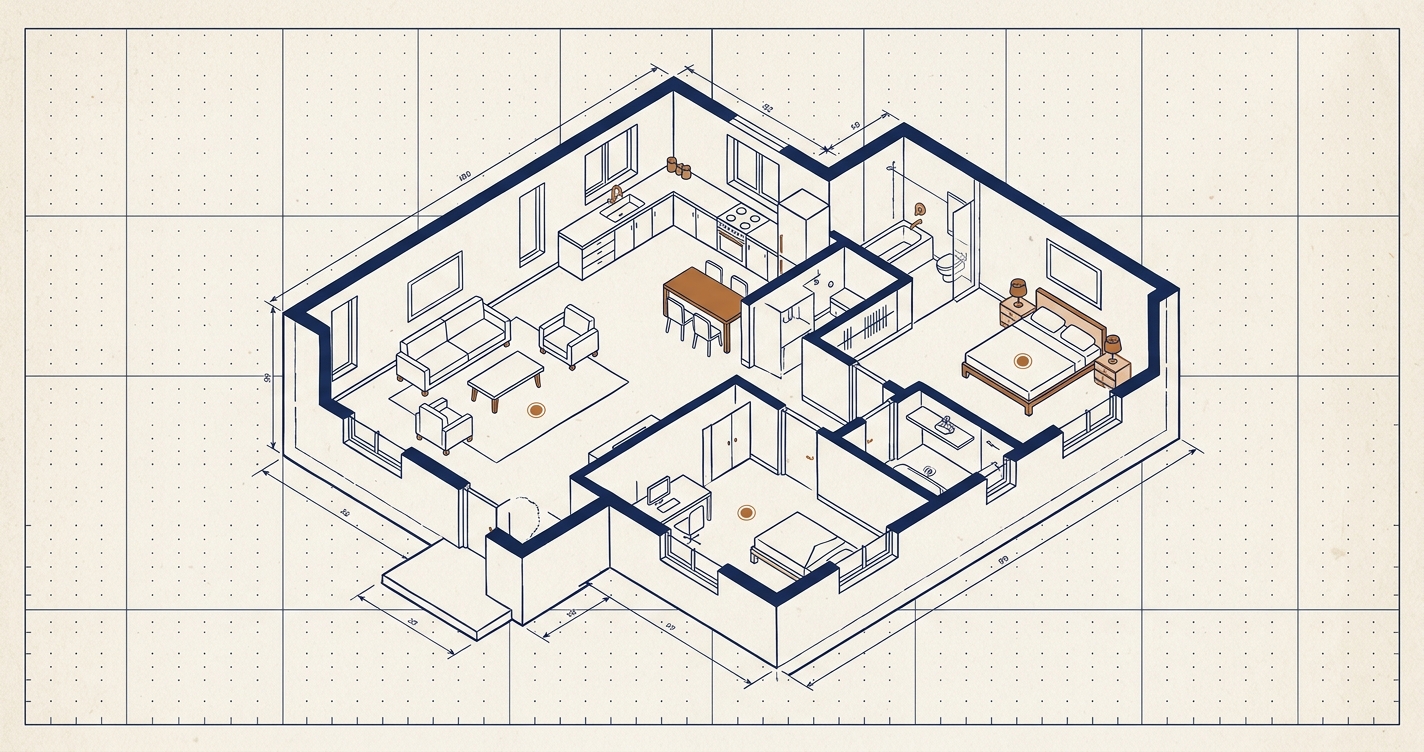
A home inventory is the written record of everything you own inside your home, organized in a format your insurance company can work from after a loss. For most households it's the single most valuable document they don't yet have.
This is the complete guide to building one — why it matters, what coverage you actually have, how to document each category of belongings, where to store the record so it survives the event that requires it, and what happens when you file a claim.
Why a Home Inventory Matters
Insurance claims after a total loss are won or lost on documentation. The Insurance Information Institute has recommended a written inventory to every U.S. homeowner for decades. And for decades, the majority haven't built one.
The III's Facts + Statistics on homeowners insurance tells the story of why it matters: wind and hail are the most frequent source of claims, but fire and lightning produce the highest average payout per claim. Fire is also the category most likely to destroy documentation along with the items it's documenting. The total-loss scenario is where undocumented homeowners lose the most — typically tens of thousands of dollars of settled value they couldn't prove they owned.
The psychology is worse than the math. After a traumatic loss, most people can recall 30–40% of what they owned. The rest is simply gone from memory — items in closets, on shelves, in the back of cabinets, in the garage, in the attic. An adjuster starting from your list pays out based on what you documented. An adjuster waiting for you to remember pays less.
What Your Insurance Actually Covers
Before you build the inventory, understand the policy it serves.
HO-3: The Standard U.S. Homeowners Policy
The HO-3 is the most common homeowners policy form in the United States. The NAIC Consumer Guide to Home Insurance describes the standard coverage structure:
- Coverage A — Dwelling: the house itself (typically the policy's headline number)
- Coverage B — Other structures: detached garage, shed, fence (usually 10% of A)
- Coverage C — Personal property: everything you own inside (typically 50–70% of A)
- Coverage D — Loss of use: additional living expenses if your home is uninhabitable
- Coverage E — Personal liability: your legal liability to others
- Coverage F — Medical payments: minor injury to others on your property
Your inventory is the evidence for Coverage C. If your dwelling coverage is $400,000, your personal property coverage is likely $200K–$280K. To claim that full amount after a total loss, you need to prove you had that much in belongings.
Replacement Cost Value vs. Actual Cash Value
Two identical policies can pay out wildly different amounts depending on which method they use. The III's explainer on policy types covers this:
- Replacement Cost Value (RCV) pays what it costs to buy a comparable new item today.
- Actual Cash Value (ACV) pays RCV minus depreciation. For a 5-year-old TV that originally cost $1,500, ACV might settle at $500–$700.
Check your declarations page. If you're on ACV and your belongings are older than a year or two, an RCV upgrade typically costs 10–15% more in premium and can mean thousands more in a serious claim. The inventory documentation is the same either way.
Sub-Limits on High-Value Items
Standard HO-3 policies cap certain categories regardless of total Coverage C:
- Jewelry theft: typically $1,000–$2,500
- Firearms theft: typically $2,000–$2,500
- Silverware theft: typically $2,500
- Cash/currency: typically $200
- Business property: typically $2,500 on premises, $250 off
Items above these limits require a scheduled personal property endorsement — you list the item specifically on your policy, insurers get a current appraisal or receipt, and you pay a small additional premium in exchange for full coverage. If you own a $10,000 engagement ring and haven't scheduled it, a theft claim pays out $1,500 at most.
The Three Documentation Tiers
Not every item needs the same level of documentation. Tier your effort:
Tier 1: Basic (every item)
- Item description (brand, model, size, color where applicable)
- Room location
- Approximate purchase date
- Approximate purchase price or current replacement value
- A photograph
This is enough for the mass of household goods — furniture, kitchenware, clothing, bedding, small appliances.
Tier 2: Detailed (items with serial numbers)
Everything in Tier 1, plus:
- Serial number (electronics, appliances, power tools, bicycles, firearms)
- Receipt or proof of purchase
Serial numbers serve two purposes: they prove you owned the specific item rather than "a TV," and if the claim involves theft, police use serial numbers to recover stolen property.
The easiest time to capture a serial number is at installation. A 10-second photo of the back or bottom of an appliance while you're setting it up is dramatically easier than trying to move a refrigerator to find the number after the fact.
Tier 3: Scheduled (high-value items)
Everything in Tier 2, plus:
- Professional appraisal (for jewelry, fine art, antiques, collectibles)
- Provenance documentation (for art and antiques — artist, gallery, date acquired)
- Detailed photographs (multiple angles, hallmarks visible, condition notes)
- Scheduled on your policy with the insurer
Anything above your policy's sub-limit for its category needs Tier 3.
Room-by-Room Approach
The spoke checklist guide covers every room in detail. The short version of how to approach the project:
- Start with the most valuable rooms first. Primary bedroom, home office, living room tend to contain the highest-value items per square foot.
- Work one room at a time. Don't try to catalog everything in one session. Two rooms per weekend spreads the effort across a month and you finish with better documentation than if you tried to do it all at once.
- Use your phone's camera + the DwellRecord app, or your phone's camera + a spreadsheet. The capture surface matters more than the format.
- Open the drawers and closets. The adjuster isn't impressed by a tour of visible surfaces. Inventory what's inside.
- Photograph groups, catalog individually. For clothing, "15 dress shirts, mid-range department-store brands" with a photo of the closet is enough. You don't need an entry per shirt.
Scheduled Items: When to Add an Endorsement
Schedule an item when any of these are true:
- Its value exceeds the policy sub-limit for its category
- It has irreplaceable or sentimental value (engagement ring, heirloom jewelry, original art)
- You've had it professionally appraised
- You'd fight hard to replace it at full value after a loss
Practically, this means: engagement rings and anniversary jewelry, watches over $1,000, original art, inherited silver, firearms collections, musical instruments used professionally, serious camera gear, wine collections above a few thousand dollars.
Scheduling usually adds $5–$30 per year per item. For a $10,000 ring, that's $50–$100 per year to go from $1,500 coverage to $10,000 coverage.
Storage: The Inventory That Survives
The most important rule in home inventory: don't store your only copy in the home you're documenting.
A home inventory on a laptop that burns in a house fire is worthless. Your inventory needs to live outside the structure.
Options ranked by how well they survive real events:
- Cloud-based inventory app — automatically syncs, accessible from your phone, exportable as PDF. Best.
- Cloud storage (Google Drive, Dropbox, iCloud) — works if you actually remember to upload updates. Easy to let go stale.
- USB drive in a safe deposit box — reliable but inconvenient to update.
- External hard drive at a different location — family member's house, office. Works but easy to forget to update.
- Printed copy in a fireproof safe — better than nothing, but paper doesn't capture photos well and doesn't scale.
- Everything on one device inside the home — worthless after a real event. Don't rely on this.
DwellRecord stores the inventory in the cloud, room by room, with photos and serial numbers attached to every item. When you need to file a claim, you export a single PDF with everything the adjuster needs — accessible from anywhere, including a hotel room after an evacuation.
How to Keep It Current
An inventory is only as good as its last update. The trick is making updates habitual, not a project.
Update events:
- Any purchase over $100 → add to inventory before you throw away the receipt
- A new appliance or electronic → photo the serial number at installation
- A renovation or remodel → document the new fixtures, flooring, built-ins (these double-count — they're both improvements to basis and new items in your inventory)
- An annual walk-through — pick a month (many people use January), spend an hour catching anything missed
When Disaster Strikes: The Claim Filing Process
The first 72 hours after a loss are chaos. A good inventory makes the next 72 days survivable.
Immediate (first 24–48 hours)
- Ensure safety. Get out. Confirm everyone is accounted for.
- Contact your insurer's claim line. Get a claim number.
- Temporarily secure the property if accessible and safe (board windows, tarp roof).
- Photograph the damage before you touch anything.
- Save receipts for emergency expenses — hotel, clothing, essentials. Coverage D reimburses these.
First Week
- Meet with the field adjuster. They'll walk the property, note damage, request documentation.
- Provide your home inventory. This is when months of quiet documentation pays off in hours.
- Get independent repair estimates for major damage.
- Keep a claim journal — every call, every person, every date. Write it down.
First Month
- Review the insurer's scope of loss document carefully.
- Dispute items where the adjuster's valuation differs materially from your documented replacement cost.
- Engage a public adjuster if the gap is large and you're not getting movement.
What Adjusters Look For
Adjusters are trained to validate documentation and flag inconsistencies. They value:
- Specificity over generality ("Samsung QN65Q80C, 2023, wall-mounted" beats "65-inch TV")
- Receipts or serial numbers over claimed ownership
- Photos dated before the loss (metadata matters)
- Consistent documentation standards across categories (suggests real inventory, not post-loss reconstruction)
They flag:
- Round numbers with no documentation
- Sudden acquisition of high-value items shortly before the loss
- Ownership claims without any supporting evidence
- Categories that seem inflated relative to the structure and neighborhood
Your inventory's job is to present as "real, kept, current" rather than "assembled under stress after a loss."
Renters Need This Too
Renters insurance covers your personal belongings, not the building. If you rent, the inventory matters just as much. Your landlord's policy does not cover your laptop, your furniture, your clothing, or your kitchen contents.
Same process, same tiers, same storage rules.
Related Guides
- Home Inventory Checklist for Insurance Claims — the room-by-room list of what to document.
- RCV vs. ACV: Which Coverage You Actually Have — the settlement method that determines payout.
- How to File a Homeowners Insurance Claim — step-by-step process from first call to final settlement.
- Scheduling Jewelry, Art, and High-Value Items — endorsements for items above standard sub-limits.
- Wildfire Preparedness: The 48-Hour Documentation Window — the pre-evacuation playbook.
- Do Home Improvements Cut Capital Gains Tax? — the tax parallel to inventory documentation.
- Documents Needed When Selling Your House — including which improvement and inventory records to transfer or retain.
The Bottom Line
Insurance pays what you can document. That's the whole principle.
Spend the weekends now to build the record. Keep it in the cloud. Update it when things change. And hope you never need it — but know that if you do, an adjuster is going to open your PDF and pay out based on what's on the pages, not on what you try to remember from a hotel room at 2am.
Start your free room-by-room home inventory.Editorial, not advice. This article is educational and reflects publicly available IRS, state, and insurance guidance at the time of writing. It is not tax, legal, or insurance advice. For decisions that touch your specific situation, consult a CPA, enrolled agent, tax attorney, or licensed insurance professional in your state. DwellRecord keeps the record — your advisor makes the call.
Last reviewed:
Ready to protect your home investment?
Start documenting your improvements, assets, and warranties for free.
Get Started Free